
(Blog) [AI · RAG · Enterprise Search · Knowledge Assistants · UAE]
Enterprise RAG Search: How AI Can Use Your Real Data Without Leaking or Misusing It
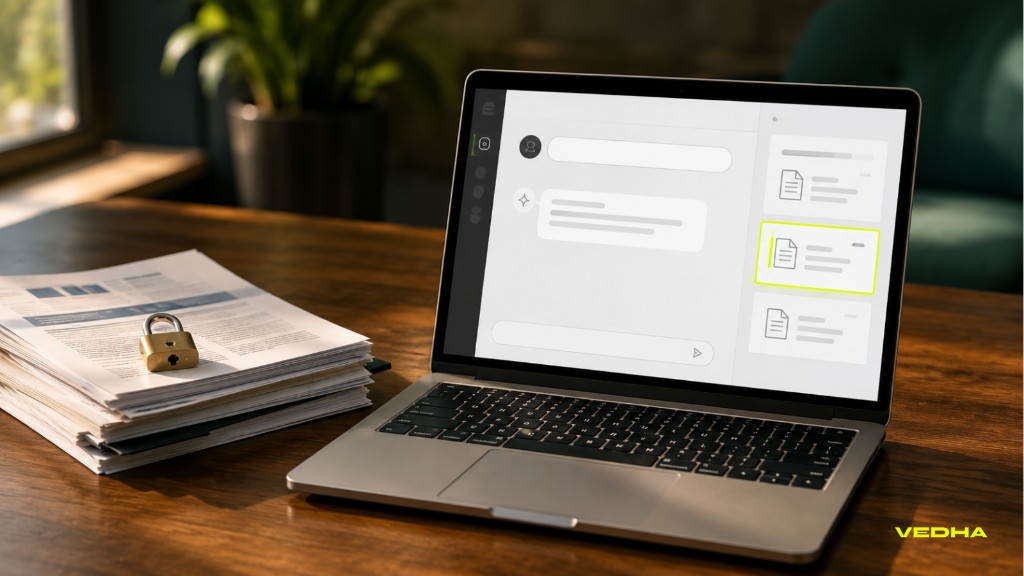
73% of enterprise AI pilots fail because they cannot access the right internal data securely, according to industry analysis. Enterprise RAG (retrieval-augmented generation) search solves this by grounding AI responses in your actual documents, policies and data without exposing sensitive information or hallucinating answers.
This guide covers what enterprise RAG search is, how it compares to traditional search, architecture options, UAE-specific use cases, governance requirements and implementation considerations for secure AI deployment.
Quick answer: Enterprise RAG search combines retrieval-augmented generation with your company's documents to deliver accurate, cited answers while maintaining strict access controls. Success requires hybrid retrieval (vector plus keyword), permission-aware architecture, data residency compliance and clear governance frameworks. Most UAE businesses benefit from starting with managed platforms for standard use cases, then moving to custom builds for complex requirements.
What is enterprise RAG search?
Enterprise RAG search works like a search engine combined with an AI assistant. Instead of returning document links like traditional search, RAG retrieves relevant content from your knowledge base and generates direct answers with citations.
The technology addresses a fundamental problem with generic AI tools. ChatGPT and similar platforms train on public internet data, which means they cannot access your internal policies, product documentation or customer records. They also hallucinate when uncertain. Private AI with company data solves this through retrieval augmented generation enterprise architectures.
How it differs from ChatGPT:
- Grounded in your data, not trained on public internet
- Answers stay current as documents update
- Respects existing access controls and permissions
- Reduces hallucinations by constraining AI to retrieved context
The two-step process:
- Retrieval: Find 5 to 10 most relevant document chunks based on query
- Generation: LLM generates answer using only retrieved content, with citations
Enterprises care because RAG reduces hallucinations, improves answer accuracy and maintains data control. This matters for regulated industries and sensitive business information where AI data security enterprise standards apply.
How does enterprise RAG search compare to traditional search?
Organisations often ask whether they should replace existing search infrastructure with RAG. The answer depends on the use case. Traditional search and RAG serve different purposes, and most enterprises need both for comprehensive enterprise search with generative AI capabilities.
| Feature | Traditional search (SharePoint, Elasticsearch) | RAG search |
|---|---|---|
| Output | Document links and snippets | Direct answers with citations |
| User effort | User must read and synthesise | AI does the synthesis |
| Best for | Exact match queries, faceted filtering, known-item searches | Natural language questions, multi-document synthesis |
| Example query | "ISO 27001 policy PDF" | "What does our policy say about data retention?" |
| Accuracy | High for exact matches | High for conceptual questions |
When traditional search wins:
- Exact document titles or IDs
- Faceted filtering by date, author or department
- Browsing and discovery
When RAG wins:
- Natural language questions
- "What does policy X say about Y?"
- Multi-document synthesis such as "Summarise all projects using vendor ABC"
Most enterprises need both. Use RAG for Q&A and traditional search for browsing and filtering. This hybrid approach powers effective enterprise knowledge base AI systems.
What does enterprise RAG architecture look like?
Enterprise RAG architecture comprises four interconnected layers. Each layer handles a specific function, from ingesting documents to generating answers. Understanding these components helps when evaluating vendors or planning custom builds for secure LLM deployment.
Data ingestion pipeline: Connectors pull documents from your existing systems like SharePoint, Google Drive, databases and APIs, then process and prepare them for AI retrieval. The system handles different file types, languages including Arabic, and document structures automatically so your team does not need to manually organise content.
Vector database and indexing: Your documents convert to searchable formats that AI can understand and retrieve from quickly. You can choose from various platforms depending on your existing cloud infrastructure, with most businesses selecting options that integrate with their current Microsoft, Google or AWS environments for RAG architecture for business needs.
Retrieval and generation layer: When someone asks a question, the system finds the most relevant information and generates a clear answer with citations. This layer connects to AI models like Azure OpenAI or Anthropic, ensuring answers come from your actual documents rather than generic internet knowledge for reliable business intelligence with RAG.
Security and access control: The system respects your existing permissions so people only see documents they already have access to. Data stays within your chosen region, often UAE data centres for local compliance, with full audit trails tracking every query and answer to support enterprise AI governance framework requirements.
Should you build or buy an Enterprise RAG System?
Managed platforms offer faster deployment at 4 to 6 weeks with lower upfront cost but less customisation and ongoing subscription fees. Custom builds provide full control, data residency compliance and integration with legacy systems but require ML and DevOps expertise for secure LLM deployment. Vedha can help you choose between buying vs building a RAG system based on your business requirements.
Which UAE business use cases benefit most?
UAE businesses operate in a distinctive environment. Multilingual workforces, regional regulatory frameworks and sector-specific requirements shape which use cases deliver the strongest ROI for enterprise AI solutions.
Customer support and help desks: Support teams answer 200+ tickets daily using product docs, policies and past tickets. RAG provides instant answers with citations, reducing training time for new agents with multilingual support in Arabic and English from the same knowledge base.
HR and employee self-service: Employees ask about leave policies, benefits, onboarding and compliance training. RAG reduces HR ticket volume and ensures consistent answers across offices with UAE labour law compliance, visa policies and Emiratization requirements. This supports AI for internal knowledge management across distributed teams.
Legal and compliance teams: Legal teams search contracts, regulations, past cases and compliance docs. RAG enables multi-document synthesis for DIFC and ADGM regulations, UAE federal law and contract localisation where data privacy in generative AI becomes critical.
Operations and field service: Field technicians access maintenance manuals, safety procedures and troubleshooting guides. RAG enables faster resolution times and reduces dependency on senior engineers across oil and gas, construction and facilities management sectors. This is one of the enterprise search solutions Dubai businesses often start with.
Sales and pre-sales support: Sales teams need proposal templates, case studies, pricing guidelines and technical specs. RAG accelerates proposal creation and ensures consistent messaging across teams in UAE's competitive B2B environment.
What governance and security measures are required?
Governance separates production-grade RAG from proof-of-concept experiments. UAE businesses must address data residency, access control and audit requirements before deploying to production with enterprise AI governance framework compliance.
Permission mirroring: RAG inherits existing document access controls from SharePoint groups or AD roles, preventing accidental data exposure and AI data leakage through user-level access enforcement.
Data residency requirements: UAE businesses may need to keep data in-country using Azure UAE North and AWS UAE regions, with vector embeddings counting as data under Federal Decree-Law No. 45 of 2021 (UAE PDPL) where AI data governance UAE requirements vary by sector.
PII detection and redaction: Automatically mask sensitive data before indexing using Named Entity Recognition to identify and redact personal information, reducing compliance risk and supporting data privacy in generative AI initiatives.
Audit trails: Log every query, retrieved document and generated answer for compliance across regulated industries including financial services, healthcare and government, supporting secure AI deployment UAE standards and regulatory reporting.
Human-in-the-loop: Flag uncertain answers for human review before showing to users, critical for legal, compliance and customer-facing use cases to reduce liability and improve answer quality through feedback loops.
What are the common pitfalls in enterprise RAG implementation?
Teams often underestimate the operational complexity of production RAG. The following pitfalls can derail projects if not addressed early in RAG implementation for Dubai projects:
Poor document quality: Garbage in, garbage out. Audit and clean content first, removing duplicates, outdated policies and low-quality documents that produce unreliable answers regardless of architecture quality across enterprise AI search solutions.
Ignoring permissions: Building RAG that exposes documents users should not see violates AI data security enterprise standards. Always implement permission-aware retrieval from day one to avoid retroactive re-indexing and security gaps.
Over-relying on vector search: Missing exact matches when vector search excels at conceptual queries but struggles with exact product codes, policy numbers and technical identifiers. Use hybrid retrieval combining vector plus keyword for best accuracy in RAG vs fine-tuning for enterprise decisions.
No evaluation framework: Cannot measure if RAG is actually improving answers without tracking metrics like answer accuracy, user satisfaction and time saved. Enterprise AI search solutions require measurement from day one to justify continued investment.
Underestimating change management: Users will not adopt if answers are not trustworthy. Start with pilot users, gather feedback and iterate before full rollout as change management often matters more than technical architecture for adoption success.
How Vedha helps
Vedha Tech provides enterprise RAG assessment and implementation for UAE businesses. We evaluate build versus buy, design secure architecture with permission-aware retrieval and data residency compliance, integrate with existing systems, implement governance frameworks and deploy dedicated ML engineering teams.
Our approach combines technical expertise with regional compliance knowledge. We have deployed AI solutions across financial services, healthcare, government, and enterprise sectors in the UAE.
Book a consultation to discuss your enterprise RAG requirements.
FAQs about enterprise RAG search
What is the difference between RAG and fine-tuning?
RAG retrieves documents at query time with no model training, keeping answers current. Fine-tuning trains model on your data with static knowledge and is expensive to update. Use RAG for most enterprise use cases and fine-tune only for domain-specific language.
How do you prevent AI from hallucinating in enterprise RAG?
Constrain generation to retrieved context only and use citation requirements. Implement confidence scoring and fallback to "I do not know", adding human review for critical use cases to prevent AI data leakage and improve reliability.
Can enterprise RAG work with Arabic and English documents?
Yes, but it may require multilingual embedding models as not all support Arabic well. Tokenisation differs for Arabic and chunking strategies need adjustment, so test retrieval quality separately for each language before production.
What are the data residency requirements for RAG in UAE?
This varies based on the industry as financial services, healthcare and government have stricter requirements. Some businesses must keep data in UAE cloud regions such as Azure UAE North or AWS UAE, with vector embeddings counting as data under local regulations.
How long does it take to implement enterprise RAG?
MVP with one data source takes 4 to 6 weeks. Production with multiple sources and governance takes 10 to 14 weeks, while enterprise-scale deployments take 16 to 24 weeks depending on complexity and governance requirements.