
(Blog) [Web Apps · Native Apps · Mobile Development · Dubai · Strategy]
Web Apps vs Native Apps in Dubai: Which Should Businesses Build?
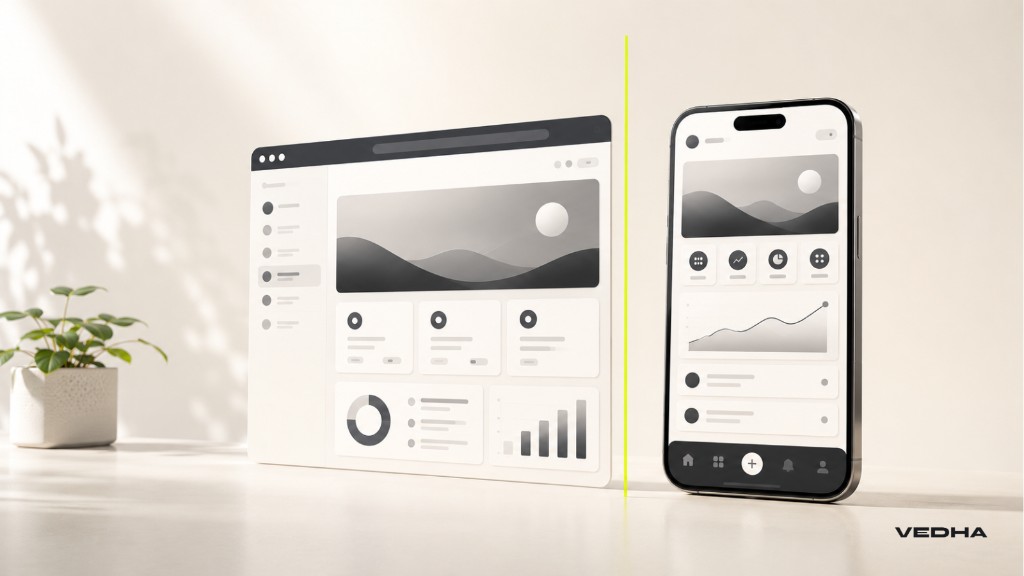
Choosing between a web app and a native app is one of the first big decisions a business makes, and it shapes cost, launch speed, adoption and maintenance for years. Web apps vs native apps in Dubai is rarely about which technology is best in the abstract. It is about which model fits your users, your budget and how fast you need to prove value.
There are really three paths, not two: a web app, a native app, and a progressive web app (PWA). This guide breaks down how they compare and which one Dubai businesses should build first.
Quick answer: Build a web app or PWA when you want lower cost, faster launch and search visibility, which suits portals, dashboards and B2B tools. Build a native app when you need device hardware, offline depth, push-led engagement or app-store presence, which suits consumer and high-retention products.
What is a web app?
A web app is a browser-based product that works across devices through a URL, with no download required. It is usually easier to launch, update, and find through search, and it can still feel powerful when designed well.
- How it works: Users open it in a browser, and updates ship centrally without app-store downloads.
- Best for: Customer portals, booking systems, dashboards, employee tools and B2B workflows.
- Strengths: Lower cost, faster launch, simple updates and strong SEO potential.
- Limits: Weaker hardware access, less native feel and limited offline support.
For example, a clinic booking portal that patients open in the browser, with no download and instant updates, is a classic web app.
Web application development is the natural fit for portals, workflows and browser-based products.
What is a native app?
A native app is built specifically for iOS or Android and installed from the App Store or Google Play. It offers the strongest device integration and mobile experience, and usually costs more to build and maintain.
- How it works: It is installed from the stores, may need separate iOS and Android builds, and updates follow store review.
- Best for: Consumer products with repeat use, loyalty, delivery or bookings, and apps that rely on push notifications, camera, location or sensors.
- Strengths: Performance, app-store visibility, deep device access and a stronger mobile UX.
- Limits: Higher cost, more complex maintenance and slower release cycles.
- Cross-platform or hybrid option: Cross-platform frameworks like Flutter and React Native build one codebase for both iOS and Android, giving near-native performance and app-store presence faster and more cheaply than two separate builds.
A food-delivery app with live driver tracking, push updates and saved cards is native territory, because it leans on the phone's hardware and notifications.
Mobile app development in Dubai fits products where the phone itself is the main surface.
Web app vs native app: the real comparison
Here is how the two compare on the factors that actually drive a business decision.
| Factor | Web app | Native app |
|---|---|---|
| Development cost | Lower, one codebase serves many devices | Higher, especially if iOS and Android are built separately |
| Time to market | Faster | Slower |
| Performance and UX | Strong for forms, portals and transactions | Best for heavy interactions and smooth animation |
| SEO and discoverability | Indexed and found through search | Relies on app stores and referrals |
| Push and engagement | Limited re-engagement | Strong notifications and retention |
| Offline and device access | Limited, depends on architecture | Deep offline and hardware access |
| Maintenance and updates | Centralised and simpler | OS, dependency and store cycles to manage |
| Cross-platform reach | Broad by default | Needs cross-platform tooling to match |
For many businesses, the decision comes down to the fastest way to validate value rather than the best technology on paper. Strong mobile app design lifts either path.
Where progressive web apps (PWAs) fit
A PWA, or progressive web app, is a website that behaves like a mobile app. Visitors open it in their browser as usual, but they can also save it to their home screen and launch it in a single tap, and it stays responsive even on a weak connection. A good example is an online store customers can save to their phone and reopen instantly, giving them an app-like experience without the cost of building and publishing separate iOS and Android apps.
- Choose a PWA when: You want fast launch, lower cost and strong search visibility, or you are still validating demand and do not want to commit to full native yet.
- Do not rely on a PWA when: The product needs deep hardware integration, intensive offline use, push-led retention or premium app-store credibility.
How to choose: a decision framework for your business
Work through these three questions and the best app development approach for your business usually becomes clear. Each one nudges you towards a web app, a native app or a PWA.
Is the phone the product, or just one way in?
If your product depends on the device itself, through the camera, GPS, sensors, background processes or heavy offline use, that points to native. If the phone is simply one of several ways people reach you, alongside desktop and tablet, a web app covers it. A field team that scans items and works offline needs native; a portal people check between meetings does not.
Do you need to be found on Google, or in the app store?
Discovery shapes the whole model. If organic search, easy sharing and instant access matter most, a web app or PWA wins, because the content can be indexed and no app-store download gets between you and new users. If app-store presence, push notifications and repeat-use retention drive the business, native is the stronger home.
Are you validating or scaling?
If you are still proving demand, a web app or PWA gets you to market faster and more cheaply, so you can learn before you commit. If usage is already proven and engagement is central to revenue, native earns its higher build and maintenance cost.
The bottom line:
- Build a web app when the goal is validation, search visibility or an internal workflow, such as portals, dashboards, internal tools and lead generation.
- Build a native app when hardware, retention or app-store presence matter most, such as loyalty, delivery and lifestyle apps.
- Choose a PWA when you want a mobile-like product with better SEO and lower startup cost, or to test demand before full native.
If your answers pull in different directions, a PWA is usually the safest first step.
Recommendations by business type
- Startups and MVPs: Usually start with a web app or PWA to protect budget and validate fast, then move to native when usage justifies it.
- B2B service companies: Web apps are often the strongest fit for portals, reporting and internal workflows, where search visibility beats app-store presence.
- Ecommerce and customer portals: A PWA works well for discovery and checkout, while native gets stronger when loyalty and notifications drive revenue.
- Enterprise and internal tools: Web apps suit dashboards, approvals and employee portals, with native added when staff are mobile, offline or field-based.
How much do web apps and native apps cost in Dubai?
Prices vary widely by scope, features and integrations, so treat these as indicative starting points rather than quotes.
- Web app or PWA: From around AED 10,000 for a focused first build, and more for complex portals with logins, dashboards and integrations.
- Cross-platform app, iOS and Android on one codebase: From around AED 25,000 depending on features.
- Native app, separate iOS and Android: Usually the most expensive, from around AED 60,000 and rising with scope.
How Vedha helps you choose and build the right path
As an app development company in Dubai, we advise before we build, so the platform decision is tied to your users, workflows and long-term costs rather than a trend.
- Discovery and architecture: We map business goals to the right product format before engineering starts, which prevents choosing the wrong platform too early.
- Web and native builds: Web application development for portals and dashboards, and mobile app development for iOS, Android and cross-platform consumer and field apps.
- Ongoing support: The app model shapes upkeep, so we cover website maintenance for web apps and application maintenance plus mobile development support for native.
If you are weighing the options, book a discovery call and we will recommend the path that fits your goals and budget.
FAQs about web apps and native apps in Dubai
Which is cheaper, a web app or a native app?
A web app is usually cheaper to build and maintain, because one codebase can serve multiple devices. Native apps often need separate iOS and Android development, which raises both build and maintenance cost.
Which is faster, a web app or a native app?
Native apps usually deliver stronger performance and deeper device integration. A well-built web app can still be very fast, and is often more than enough for portals, dashboards and transactional flows.
Which is better for SEO, a web app or a native app?
Web apps are generally better for SEO, because their content can be indexed by search engines. Native apps mainly live inside app stores, so they rely on store visibility, referrals and direct downloads.
Should I build a PWA or a native app?
A PWA is often the best first step when you want faster launch, lower cost and search visibility. Native is better when you need hardware access, heavy offline use or app-store presence.
What is the best app for a service business in Dubai?
A web app is often the best fit for service businesses, because it supports browser access, lead capture, dashboards and internal workflows without forcing users to download anything.
What is the best app for a B2B company in the UAE?
B2B companies usually benefit most from a web app or PWA first, especially when the core use case is lead generation, portals, reporting or internal operations.