
(Blog) [AI · AI Assistants · Operations · Finance · Sales · UAE]
Designing Custom AI Assistants for Internal Teams: Use Cases for Operations, Finance and Sales in the UAE
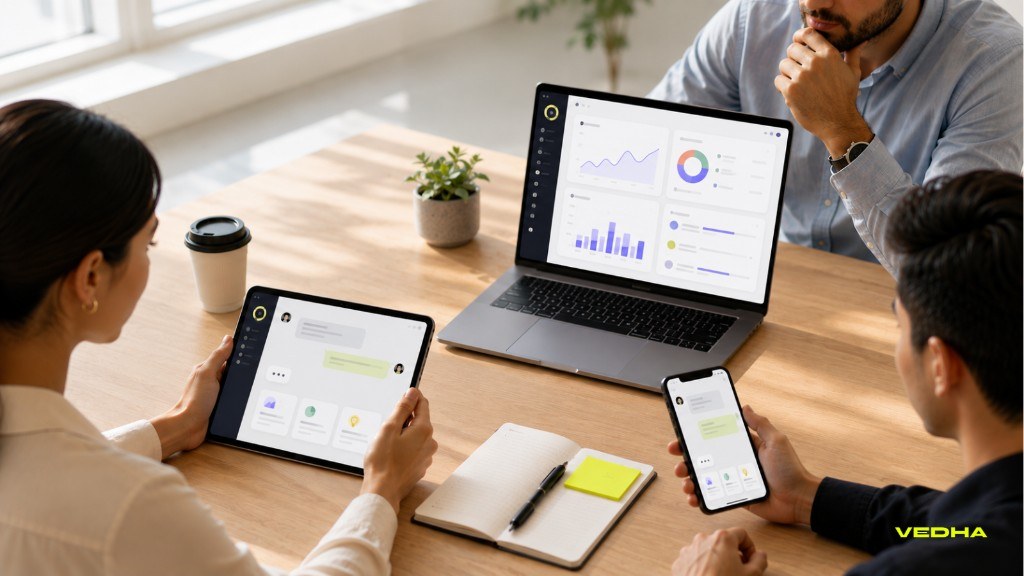
Plenty of UAE companies are experimenting with AI, yet most internal tools quietly go unused. The reason is rarely the model. It is that the tool was never designed around how the team actually works.
Custom AI assistants for internal teams flip that around. Instead of a generic chatbot bolted onto everything, they are focused helpers built for a specific team and a specific workflow, using your own data and systems. This guide shows how to design custom AI assistants for operations, finance and sales, with UAE workflow realities and governance in mind.
Quick answer: A custom AI assistant is worth building when a real workflow is repetitive, spans several systems, or touches sensitive data that off-the-shelf tools cannot safely reach. Start with one high-friction task, design the data access and guardrails around it, and measure the time it saves.
What we mean by custom AI assistants for internal teams
A custom AI assistant is a focused tool that helps a specific team with a specific workflow, drawing on internal data and connecting to the systems they already use. Some are conversational, an internal AI chatbot your team can simply ask; others quietly act across systems. Either way, it is a purpose-built, enterprise AI assistant, not a generic public chatbot or a one-size-fits-all Copilot-style add-on.
The "custom" part is about fit, not branding:
- Workflow fit: it is built around one real process, not "AI for everything".
- Data access: it reads the right systems, and nothing it should not.
- Integrations: it lives inside the tools people already work in.
Why UAE teams need custom assistants, not just generic AI
UAE teams often work across several systems, languages and legal entities at once, and generic tools handle that poorly. A custom assistant can be shaped around those realities:
- Language: Arabic and English workflows, handled properly rather than as an afterthought.
- Structure: multi-entity and free-zone reporting, where one generic view does not fit.
- Compliance: local policies, data boundaries and approval flows built in, not bolted on.
In short, a custom build is worth it when a workflow spans several systems, needs specific integrations, or handles sensitive or regulated data that must stay in a controlled environment, which is where private and on-premise AI often comes in. For standard, low-sensitivity tasks, an off-the-shelf tool is usually enough.
Design principles for internal AI assistants
Good assistants are designed, not just switched on. Four principles do most of the work.
- Start from one workflow, not one tool. Pick a single high-friction process, such as monthly reporting, invoice processing or lead qualification. Narrow scope is what drives adoption and measurable value; "AI for everything" is what kills it.
- Map data sources and access rules. List exactly which systems the assistant must read, such as your ERP, CRM, spreadsheets, shared drives or ticketing tools, then define who can access what and what must never be exposed. Assistant design is partly a data-governance exercise.
- Define guardrails and approval flows. Decide where the assistant can act alone and where a human must approve, the line between draft and send, suggest and approve, internal and external. Log sensitive actions for audit.
- Design for adoption, not just capability. Keep it simple and embed it in the tools people already use, such as Slack, Teams, email or the CRM. Train by role, then measure how teams actually use it and iterate.
AI assistants for Operations
In business operations, an AI assistant for operations earns its keep where work is repetitive and spread across systems and locations, and where AI workflow automation handles the copy-paste.
- Reporting and status updates: the assistant pulls from operational systems and drafts regular status summaries across projects, locations or entities, cutting the manual copy-paste.
- SOP Q&A and onboarding: trained on your internal SOPs and process docs, an enterprise knowledge assistant, essentially a company knowledge chatbot over your internal knowledge base, answers questions like "how do we raise a PO?" and speeds up onboarding.
- Ticket triage and handoffs: it classifies incoming requests, suggests owners and next steps, and summarises context when work moves between teams. The same pattern makes an effective AI assistant for customer support, triaging and routing queries across multiple sites or entities.
AI assistants for Finance
Finance workflows are document-heavy, cycle-driven and compliance-sensitive, which is exactly where an AI assistant for finance, backed by AI process automation, pays off.
- Invoice and document processing: it extracts data from invoices, receipts and contracts, populates finance systems through AI-assisted automation, and flags exceptions for human review, which speeds up month-end close.
- Compliance and policy queries: it answers questions on finance policies, approval limits and requirements, referencing internal manuals so junior and non-finance staff stop escalating every rule.
- Reporting and reconciliations: it helps prepare periodic reports, reconciliations and variance analyses, drafts the narrative and highlights anomalies for the team to review before submission.
AI assistants for Sales
An AI sales assistant proves its worth in pipeline quality, response speed and account insight.
- Lead qualification and routing: it scores and routes inbound leads on your criteria and history, then assigns owners and suggests next steps in the CRM, cutting response time.
- Outreach drafting and account summaries: it drafts personalised outreach from CRM data and summarises account history and key stakeholders before a meeting, so reps prepare faster and more consistently.
- Pipeline hygiene and next-best-action: it flags stale deals, missing fields and risks, and suggests the next-best-action per opportunity, which supports managers in coaching and forecasting.
Governance and security for internal AI assistants
Governance is what lets you scale an assistant beyond a nervous pilot. Keep it practical:
- Data access and permissions: define which sources the assistant can reach, using role-based access and least-privilege principles so it only sees what each user should.
- Logging, monitoring and incident handling: log the assistant's actions for audit and improvement, and decide in advance what happens when it gives wrong guidance or behaves unexpectedly. Structured AI governance and monitoring makes this repeatable.
- Human oversight and escalation: make human approval mandatory for high-risk actions such as external communications and financial approvals, with clear escalation paths for edge cases.
Measuring success: KPIs for internal AI assistants
Prove value in numbers, not novelty. Three measures cover most cases:
- Time saved: hours per month freed up on reporting, invoice processing or lead qualification, and the cycle-time reduction that follows.
- Error reduction: fewer manual data-entry mistakes, more consistent outputs and better documentation.
- Adoption and satisfaction: active users, frequency of use and team feedback, used to refine the workflow rather than just to report a number.
How Vedha designs and delivers custom AI assistants
We build assistants teams actually use, not demos that impress once and gather dust. Our AI solutions work starts with discovery and workflow mapping, then moves through data and integration design, guardrails, training and a proper handover.
Because most useful assistants sit on top of real processes, we also handle the business automation and integrations underneath, so the assistant reaches the systems it needs while staying inside your governance rules. The focus throughout is one or two high-value workflows done well, then expansion once they prove out.
FAQs about custom AI assistants for internal teams
What are custom AI assistants for internal teams?
They are focused AI tools designed to help a specific team, such as operations, finance or sales, with a specific workflow, using internal data and connecting to the systems that team already uses. The point is workflow fit, not a general-purpose chatbot.
How do AI assistants help operations teams?
By automating status reporting, answering questions from SOPs and process docs, triaging incoming tickets, and summarising context for handoffs between teams, which removes repetitive manual work and speeds up onboarding.
Is a custom AI assistant the same as an AI chatbot?
Not exactly. A chatbot is one form of AI assistant: a conversational way to ask questions and get answers. A custom AI chatbot for business, such as a company knowledge chatbot trained on your SOPs, policies and internal knowledge base, is an assistant focused on answering. Other assistants go further and take actions across your systems. Both can be private and enterprise-grade, so the difference is scope, not the label.
How do AI assistants help sales teams?
By qualifying and routing leads, drafting personalised outreach, summarising accounts before meetings, and suggesting the next-best-action on each opportunity, so reps respond faster and pipelines stay clean.
Are custom AI assistants secure for internal use?
Yes, when they are designed with proper data access controls, role-based permissions, logging and human oversight. Security depends on the implementation and governance around the assistant, not on the model alone.
What is the difference between AI assistants and AI agents?
An assistant mainly supports and augments a person's work, with a human in the loop. An agent takes more autonomous actions within defined guardrails. The terms overlap in practice, but "assistant" implies more human oversight, which is usually the safer starting point for internal work.
Want to find where an assistant would actually help? Book a discovery session and we will identify one or two high-impact workflows in operations, finance or sales where a custom AI assistant could save time, cut errors and improve decisions.