
(Blog) [MVP · Startups · Product Strategy · Dubai · Web Development]
MVP vs Full Product: How Dubai Startups Should Decide What to Build First
Plenty of startups burn their first budget on the wrong starting point. Some build far too much before anyone has paid for anything; others ship something so thin that serious buyers walk away. The MVP vs full product decision is where that mistake is usually made or avoided.
This guide is written for founders in Dubai and the wider UAE, with local cost ranges, timelines and risk in mind. The aim is simple: help you choose between an MVP and a full product based on your stage, your sales model and your funding, rather than on what looks impressive on a pitch deck.
Quick answer: Start with an MVP when demand is still unproven and you need to learn fast on a tight budget. Build the full product first when you are selling to enterprise or regulated buyers, are already funded or committed, or your core value only works once several features come together.
What founders mean by MVP vs full product
The terms get thrown around loosely, so it helps to pin them down.
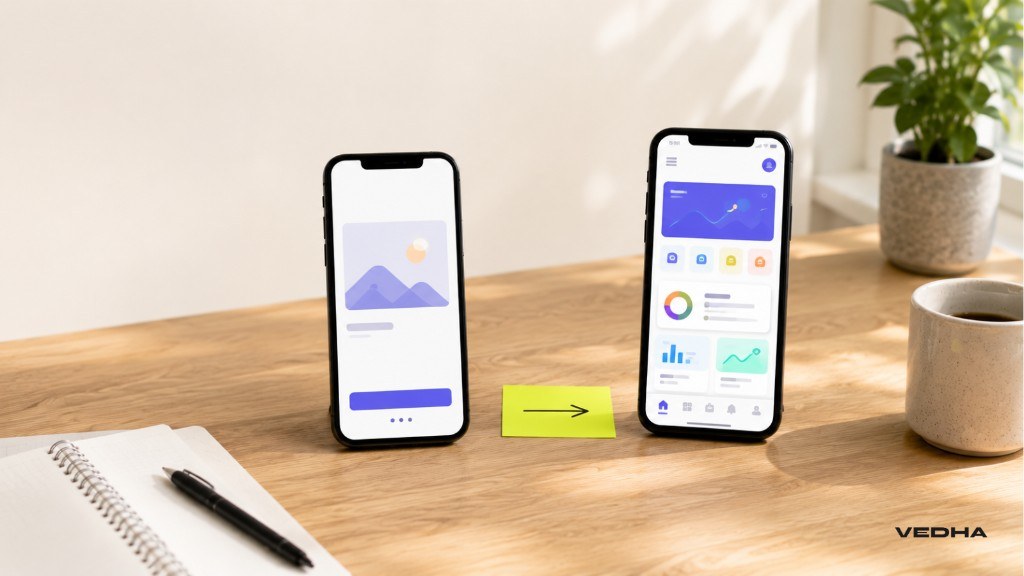
- An MVP (minimum viable product) is the smallest version that can test a core assumption with real users or buyers. It does one important job well enough to learn from, and nothing else.
- A full product is a feature-complete, scalable solution built for growth, multiple segments and broader execution.
An MVP is not a low-quality product or a throwaway. It is a focused learning tool, deliberately narrow, built to answer one question: do people actually want this, and will they pay for it? Most startups get there fastest with a lean MVP development build, then expand once the answer is yes.
When an MVP is the right choice
An MVP fits when uncertainty is high and you need evidence before spending more:
- You are early-stage with unproven demand or unclear product-market fit.
- You need to validate pricing, workflows or your core value before investing heavily.
- Your budget is limited and the risk is real, especially in consumer or new-category plays.
- Speed to market and learning matter more than polish right now.
In these cases, a full build is a bet placed before you have the information to place it well.
When a full product is the right choice
Sometimes launching lean does more harm than good. A full product from day one suits a few specific situations:
- Enterprise and regulated buyers. They expect completeness, security and support before they will commit, and an obvious test version rarely clears procurement.
- Brand-sensitive launches. When the product is your first impression in the market, a rough MVP can undercut trust before you have earned it.
For enterprise software and B2B sales in particular, a half-finished first impression can cost you the deal. The framework below will tell you whether your situation truly calls for a full build.
MVP vs full product: the key differences
Here is how the two compare on the factors founders actually weigh.
| Factor | MVP | Full product |
|---|---|---|
| Scope and features | One core job, minimal but usable | Multiple workflows, integrations and polish |
| Team and operational demands | Smaller team, simpler processes, lighter governance | Larger team, more complex workflows, stronger governance and support needs |
| Cost | Around 40% of the full product cost | The full build, so the higher upfront cost |
| Risk profile | Lower spend, but can be "too small" for some buyers | Higher spend, with the risk of overbuilding before validation |
| Best fit | Early-stage, hypothesis-driven, budget-tight, speed-focused | Funded, enterprise-facing, regulated or brand-sensitive |
On cost, a simple rule of thumb helps: an MVP generally comes in at around 40 percent of what the full product would cost, since it delivers a deliberately smaller slice of the scope. The exact figure moves with features, integrations and how much you build rather than configure.
Dubai-specific decision factors
The choice is not just about stage and funding; local realities shift it too.
- Buyer expectations. Dubai buyers, especially in B2B, often expect a higher level of polish and reliability than a purely experimental product. A rough MVP can read as unserious to a corporate procurement team.
- Language and reach. If your market is bilingual, plan for Arabic and English with right to left support and a credible .ae presence, even in an early build.
- Compliance and trust. Basic legal pages, privacy handling under the UAE Personal Data Protection Law, and clear data practices matter sooner here than founders expect.
- Payments and integrations. Local payment gateways and the tools UAE customers actually use should shape even a minimal launch, since a checkout that does not fit the market is not viable.
None of this means you must build everything up front. It means your MVP should still feel trustworthy to a UAE buyer.
A simple decision framework for founders
Work through these five questions honestly. The more you answer "yes" to the first four, the more a full product makes sense.
- Do we have signed pilots or strong buyer commitments?
- Are we selling to enterprise or regulated buyers?
- Does our core value depend on multiple features or integrations?
- Do we have enough funding to support a full build without immediate revenue?
- How much uncertainty remains about demand and product-market fit?
Map your answers like this:
- Mostly no, high uncertainty: start with an MVP and learn.
- Mostly yes, low uncertainty: build the full product, or a strong first version of it.
- A mix: go hybrid. Build a focused MVP core with the architecture and roadmap for a full product already in place. A quick build-versus-buy analysis can also settle which parts to build and which to adopt.
Common mistakes when choosing MVP or full product
- An MVP too small to be taken seriously by the buyers you are targeting, especially in B2B.
- Overbuilding a full product before demand or pricing is validated, which is the most expensive mistake of all.
- Confusing an MVP with a landing page or demo. An MVP has to deliver real value to real users, not just describe it.
- Ignoring SEO, content and trust signals from day one, then wondering why no one finds or believes in the product.
- No plan for evolving from MVP to full product, so the first build becomes a dead end that has to be rebuilt.
How to plan the upgrade path from MVP to full product
The best MVPs are built to grow up. Even a lean first version should have clean architecture, a clear data model and room for new features, so scaling later is an expansion rather than a rewrite.
Watch for the signals that it is time to move beyond the MVP:
- Investor conversations that need a more complete product story.
- Paid traction and consistent usage from real customers.
- Enterprise deals that demand security, support and depth.
- New hires, new offers or new segments to serve.
- SEO and content starting to mature and drive inbound demand.
A sensible path runs in phases: MVP, then a validated core, then targeted feature expansion, then the full product. When that expansion arrives, it often overlaps with a website and product redesign to match the more mature offering.
How Vedha helps startups choose and build
We help founders make this call before a dirham is spent in the wrong direction. Through technology consulting and strategy, we assess your stage, market and budget, then recommend an MVP, a full product or a hybrid, with a clear roadmap and honest cost ranges.
We also build both. Whether it is a lean web application MVP, a mobile app first version or a full platform, we focus on what your business actually needs now, with the architecture to grow into what it needs next. No vanity features for the pitch deck, just the shortest credible path to traction.
FAQs about MVP vs full product in Dubai
Should startups build an MVP or a full product first?
In most cases, an MVP first, so you can validate demand before committing a large budget. The exception is when you are enterprise-facing, already well-funded or committed, or selling to buyers who expect a complete solution from day one.
How much does an MVP cost in Dubai?
As a rule of thumb, an MVP tends to cost around 40 percent of what the equivalent full product would cost, since it delivers a deliberately smaller slice of the scope. The actual figure depends on the features, integrations and whether you build or configure, so the most reliable number comes from scoping your specific build.
When is an MVP not enough?
When you are selling to enterprise or regulated buyers, when the core value depends on several integrated features, or when brand and trust require a complete, polished solution from launch.
Can we start with an MVP and move to a full product later?
Yes, and for most startups that is the recommended path. The key is to build the MVP with a clear upgrade roadmap and clean architecture, so the move to a full product is a planned expansion rather than a costly rebuild.
Not sure whether to launch lean or build full? Book a strategy session and we will help you decide between an MVP and a full product, with a clear roadmap and a realistic cost estimate.