
(Blog) [Corporate Websites · Web Design · UX · Conversion · Dubai]
Corporate Website Design for Growing Dubai Brands: Balancing Brand Identity, UX and Conversion Goals
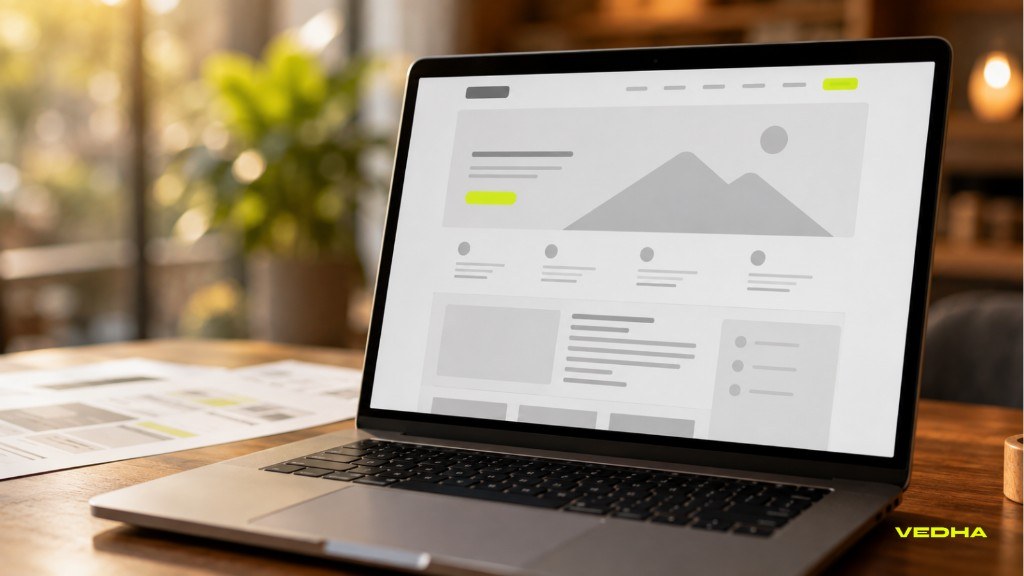
A corporate website is often the first serious interaction someone has with your business. Before a prospect books a call, requests a proposal or speaks to your sales team, they may already have formed an opinion based on how clearly your website explains what you do.
That makes corporate website design in Dubai about more than visual polish. A growing brand needs a website that communicates its position, supports different audiences, builds trust and turns the right visits into meaningful business conversations.
Quick answer: The best corporate websites balance three things: a distinctive brand identity, a clear user experience and conversion paths that guide visitors towards the right next step.
Why growing Dubai brands outgrow basic corporate websites
A basic website may be enough when a company has one service, one audience and a simple enquiry path. However, a growing Dubai brand may need to communicate:
- A wider service or product portfolio.
- Multiple industries or customer segments.
- New locations across the UAE or GCC.
- Different journeys for prospects, partners, investors and candidates.
- More detailed case studies and proof points.
- Stronger lead capture and CRM integration.
- Arabic and English content experiences.
- A content structure that supports SEO and ongoing publishing.
The challenge is not simply adding more pages; more pages without a clear structure usually create a website that is harder to navigate and maintain. A strong corporate website gives growth somewhere to go. It creates a flexible system for new services, industries, locations, insights and campaigns without making the experience feel fragmented.
If the existing website is no longer fit for purpose, the first question may be whether it needs a redesign or rebuild. See our guide to website redesign vs rebuild in Dubai for that distinction.
How brand identity shapes a Dubai corporate website
Brand identity is not just your logo, colours and typeface. It influences how people understand your business and what they expect from the experience.
A corporate website should translate your brand into:
- A clear value proposition.
- A consistent tone of voice.
- Intuitive navigation labels.
- A recognisable visual language.
- Meaningful use of imagery, illustration and motion.
- A clear way of presenting services and capabilities.
- Consistent case-study and proof-point formats.
- Calls to action that sound like your brand.
For example, an enterprise technology company may need to communicate technical confidence, security and scalability. A professional-services firm may need to make expertise, trust and industry experience more visible. A consumer brand may need a more expressive and engaging experience. The design should reflect those differences without sacrificing clarity.
Brand consistency across every website touchpoint
A consistent website does not mean every page should look identical. It means the same underlying rules are applied across the experience:
- How headings are written.
- How benefits are explained.
- How services are structured.
- How evidence is presented.
- How buttons and forms are labelled.
- How imagery supports the message.
- How new pages are added over time.
A design system and reusable content components help growing teams publish efficiently without weakening the brand.
Designing UX for Dubai corporate audiences
Corporate websites rarely have only one audience. Even if lead generation is the main objective, other people may visit the website before a deal moves forward. Common audiences for a website may include:
- Prospective customers.
- Enterprise procurement teams.
- Investors.
- Partners and suppliers.
- Candidates.
- Existing customers.
- Journalists and industry stakeholders.
Each audience may be looking for something different. A prospective customer may want to understand your services and results. An investor may look for company information and growth signals. A candidate may want to understand your culture and opportunities. A partner may be looking for capabilities, credentials or integration information.
The website does not need a separate homepage for every audience. It needs clear pathways that help visitors find the information most relevant to them.
Use content pathways instead of one-size-fits-all navigation
Don't force your visitors through the same journey on your website. Instead, there are different ways to think about content pathways:
- Services.
- Industries.
- Solutions.
- Case studies.
- Insights.
- About the company.
- Careers.
- Partners.
- Contact or consultation.
The right structure depends on how customers think about their needs. A technology company may organise content around industries and solutions. A professional-services business may lead with services and expertise. A multi-brand group may need separate pathways for brands, locations or business units.
Designing a conversion-focused corporate website in Dubai
Conversion design is not about filling every section with buttons. It is about helping the right visitor take the right next step. A high-performing corporate website usually needs the following:
- A clear homepage value proposition.
- Service pages organised around customer problems.
- Industry pages where buying journeys differ.
- Case studies with specific evidence.
- Trust signals close to important decisions.
- Calls to action that match visitor intent.
- Short, focused forms.
- Clear expectations about what happens after submission.
- CRM and marketing automation integration.
Not every visitor is ready to request a proposal. A simple journey may look like this:
| Visitor intent | Useful next step |
|---|---|
| Early research | Read an insight or explore an industry page |
| Evaluating options | Review a service page or case study |
| High intent | Book a consultation or submit an enquiry |
| Existing customer | Contact support or access a relevant portal |
This is why one generic "Contact us" button is rarely enough. A growing corporate brand may need several conversion paths, each designed for a different stage of the decision.
Build trust before asking for action
People are more likely to enquire when the website answers their concerns before they submit a form.
Below are a few examples of useful trust signals for website visitors:
- Relevant client examples.
- Specific outcomes.
- Case studies.
- Industry experience.
- Certifications or credentials.
- Leadership information.
- Clear service descriptions.
- Transparent process information.
- Testimonials where appropriate.
- Strong contact and response details.
Avoid vague claims such as "we deliver world-class solutions" unless the website supports the claim with evidence.
Building scalable corporate websites for UAE growth
A growing brand should not build a website as a collection of unrelated pages. It should create a system that can support new content and business requirements, such as:
- Reusable page templates.
- Modular content sections.
- Structured case studies.
- Consistent service-page layouts.
- Industry and location page frameworks.
- CMS permissions and publishing workflows.
- A design system.
- Analytics and reporting.
- CRM and marketing integrations.
- Performance and technical SEO standards.
The CMS should suit the organisation's operating model. A traditional CMS may be appropriate when the website is primarily a content and marketing channel. A headless CMS may be better when content needs to serve websites, apps, portals or other digital products. Our guide on the best CMS in UAE for your website can help you understand the pros and cons of each choice.
Design for future content and product growth
When designing a scalable website, make sure there is room for:
- New services and sectors.
- New locations.
- Campaign landing pages.
- Insights and resources.
- Case studies.
- Customer portals.
- Product or platform experiences.
The aim is to create flexibility without making every page look identical.
Dubai-specific requirements for corporate website design
Local context matters, even when a Dubai-based company sells internationally. A corporate website for a growing UAE brand may need to account for:
- Arabic and English content pathways.
- Right-to-left design where required.
- Mobile-first browsing.
- WhatsApp as an enquiry channel.
- Local SEO and location pages.
- GCC expansion.
- Multiple offices or service locations.
- Enterprise buyer expectations.
- Clear privacy and legal information.
- Regional language and cultural context.
Localisation should be more than translating the English version. Navigation, page hierarchy, forms, calls to action and proof points may need to reflect how different audiences use the website.
The same principle applies when a Dubai brand expands across the GCC. The site should be structured so new markets can be added without duplicating content or creating confusing navigation.
How to evaluate a corporate website design
Before approving a corporate website design, ask:
- Can a new visitor understand the business quickly?
- Is the value proposition clear?
- Does the visual identity feel distinctive and credible?
- Can each important audience find a relevant path?
- Are services explained around customer needs?
- Do case studies provide useful proof?
- Are calls to action visible at the right moments?
- Does the site work well on mobile?
- Can the internal team update content efficiently?
- Are accessibility, performance, SEO and analytics included?
- Can enquiries connect to the CRM or sales process?
- Does the website support future services, locations and campaigns?
A website should be judged by more than whether the homepage looks attractive. It should be evaluated by whether it improves understanding, trust, usability and measurable business outcomes.
How Vedha approaches corporate website design in Dubai
At Vedha, we start by understanding the business, its users and its goals rather than treating the website as a collection of screen. This includes, but is not limited to, the following:
- Brand and positioning clarification.
- Audience and stakeholder discovery.
- Information architecture.
- Customer journey and user-flow design.
- Wireframes and interactive prototypes.
- High-fidelity UI design.
- Design systems and reusable components.
- CMS implementation.
- CRM, analytics and third-party integrations.
- Technical SEO and performance optimisation.
- Launch support and ongoing maintenance.
The aim is not to add features for the sake of it. It is to build a clear, credible and scalable digital experience that supports the business now and gives it room to grow.
If the website is part of a broader customer platform, Vedha can also support connected digital products such as loyalty and rewards apps in the UAE, customer portals, internal platforms and integrated web applications.
FAQs about corporate website design
What makes a corporate website different from a standard business website?
A corporate website usually serves multiple audiences, communicates a broader brand and service offering, and needs stronger information architecture, trust signals, content governance and conversion pathways than a basic business website.
How can a corporate website strengthen brand credibility?
It can present a consistent visual identity, clear positioning, relevant proof points, case studies, expertise and a polished user experience across desktop and mobile.
How do UX and branding work together?
Branding creates recognition and trust, while UX makes the website easy to understand and use. A successful corporate website combines a distinctive identity with clear navigation, logical page structures and useful calls to action.
How can a corporate website generate more qualified leads?
It should clearly explain the value proposition, organise services around customer needs, include relevant proof points, provide audience-specific calls to action, use focused forms and connect enquiries to CRM or marketing systems.
What pages should a growing corporate brand include?
Most growing brands need a homepage, company or About page, service or solution pages, industry pages where relevant, case studies, insights or resources, contact and enquiry pages, careers content, and legal or privacy information.
Planning a corporate website for a growing Dubai brand? Explore Vedha's corporate website design services and start with a conversation about your brand, users and business goals.