
(Blog) [RAG AI · RAG Systems · AI Solutions · Enterprise AI · Knowledge Assistants · UAE]
RAG Systems: 15 Real-World Applications of RAG AI
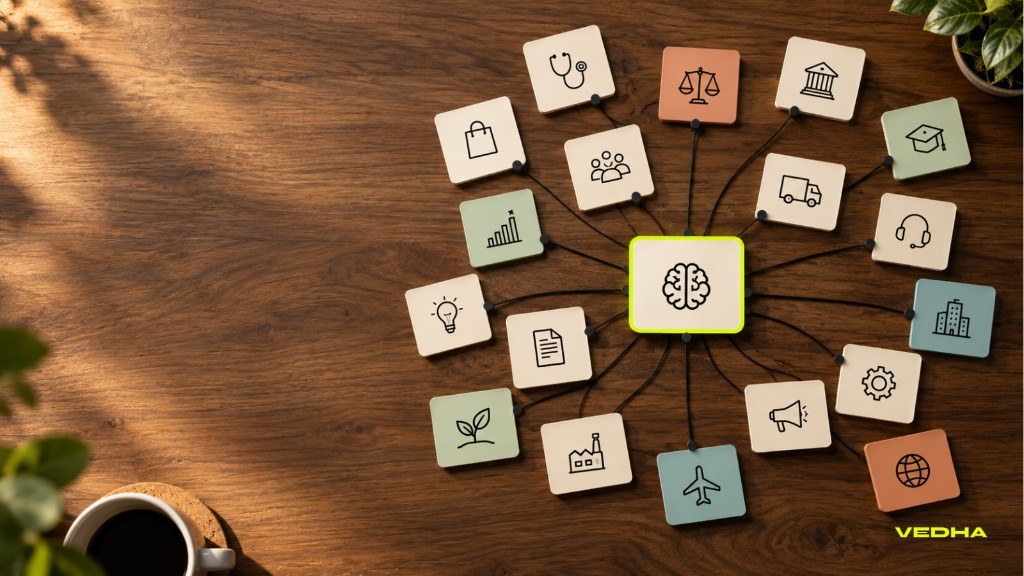
What would your teams do with faster access to reliable business information? RAG AI helps turn documents, policies, product data and operational knowledge into practical answers. This guide focuses on RAG use cases, with examples for enterprise teams, frontline workers, sales, education, legal, healthcare, HR and technical support.
Quick answer: RAG AI connects a generative AI model to an approved knowledge base, retrieves relevant content and uses it to produce a grounded response. Common RAG applications include enterprise document archives, internal assistants, call-centre support, sales enablement, AI tutors, legal research, healthcare knowledge tools, HR assistants and technical troubleshooting.
What does RAG AI do?
RAG AI retrieves relevant information from approved sources before generating an answer. This lets an AI assistant work with a company’s own documents, databases, policies or knowledge base without retraining the underlying model whenever information changes.
A typical RAG system connects:
- Data sources: Documents, websites, CRM records, knowledge bases, tickets or databases.
- Retrieval: Search that identifies relevant passages for a question.
- Generation: A language model that uses the retrieved content to form an answer.
- Controls: Access permissions, citations, monitoring and escalation rules.
For a deeper explanation of architecture, permissions and enterprise knowledge search, see Vedha’s guide to enterprise RAG search.
What are the most practical RAG AI use cases?
The following RAG examples show how organisations can apply RAG systems to specific users and workflows. Each application focuses on the challenge, how RAG AI helps and what the solution could look like in practice.
1. Enterprise document archives
- The challenge: Operations managers need to locate current policies, project files and procedures without relying on colleagues to identify the correct version.
- How RAG AI helps: A RAG assistant searches approved documents and returns answers with links to relevant sources while preserving document-level permissions.
- Example: A facilities company uses an internal assistant to help managers find the latest health and safety procedure for a specific site.
2. Frontline-worker assistants
- The challenge: Field technicians need accurate instructions at the point of work, where waiting for a supervisor or checking a manual can delay a job.
- How RAG AI helps: A mobile RAG assistant retrieves instructions from manuals, checklists and standard operating procedures, giving workers a consistent first source of guidance.
- Example: A maintenance company gives technicians an assistant that explains the correct service steps for a specific equipment model.
3. RAG for call-centre agent assistance
- The challenge: Call-centre agents must respond quickly while verifying plan rules, product details or troubleshooting steps during live customer conversations.
- How RAG AI helps: During the call, the system surfaces relevant guidance and supports consistent responses while allowing complex cases to move to a supervisor.
- Example: A telecoms provider gives agents an assistant that surfaces plan rules and cancellation policies based on the customer’s question.
4. RAG for customer support
- The challenge: Support teams repeatedly respond to routine product and service questions, while customers may struggle to locate accurate help-centre information.
- How RAG AI helps: A customer-facing RAG assistant answers routine questions from approved content and routes complex issues to a person.
- Example: A software company uses a support assistant that explains a feature from current product documentation and creates a ticket when the issue needs investigation.
5. RAG for sales enablement
- The challenge: Sales teams need to prepare for meetings by locating relevant product information, case studies, pricing guidance and account context.
- How RAG AI helps: A RAG sales assistant prepares meeting briefs, retrieves relevant proof and answers questions using approved commercial content.
- Example: An industrial supplier helps account managers find product specifications and customer references for a manufacturing prospect.
6. RAG for proposals and RFPs
- The challenge: Proposal teams must compare previous submissions, certifications and project evidence under tight deadlines without carrying outdated answers into a new response.
- How RAG AI helps: RAG retrieves relevant material and creates a structured first draft for subject matter experts to review.
- Example: An IT services company uses a proposal assistant to find previous responses about security, delivery methods and similar client projects for a new tender.
7. RAG for education and AI tutors
- The challenge: Students need explanations outside lessons, while educators answer repeated questions about course materials, assignments and procedures.
- How RAG AI helps: A RAG tutor responds using approved textbooks, lesson content and course guidance, then directs learners to the relevant material.
- Example: A training provider gives learners an assistant that explains a topic using its course materials and directs them to the relevant lesson.
8. RAG for legal research
- The challenge: Legal teams need to interpret legislation, case law, contracts and previous advice while reducing the risk of relying on an outdated or incomplete source.
- How RAG AI helps: A RAG legal assistant retrieves relevant authorities and links answers to the underlying documents for professional verification.
- Example: A law firm uses RAG to find clauses in previous contracts that relate to a new client’s procurement requirement.
9. RAG for healthcare knowledge assistants
- The challenge: Healthcare staff must locate current clinical guidelines, product information and internal procedures while maintaining professional and patient-safety standards.
- How RAG AI helps: A RAG assistant retrieves approved, source-linked information and escalates questions that require professional judgement.
- Example: A pharmacy uses an assistant to help staff find approved product guidance, storage instructions and internal dispensing procedures.
10. RAG for HR policy and employee services
- The challenge: HR teams respond to repeated questions about leave, benefits, onboarding and workplace policies while sensitive employee matters require careful handling.
- How RAG AI helps: An HR RAG assistant explains current policies and routes grievances or other sensitive matters to the appropriate HR contact.
- Example: A growing retailer uses an employee assistant to explain leave procedures and direct a complex grievance to HR.
11. RAG for technical support
- The challenge: Support engineers need to diagnose recurring issues using product manuals, release notes, known issues and previous tickets.
- How RAG AI helps: A RAG assistant retrieves relevant troubleshooting steps, preserves the conversation in the ticketing system and identifies cases that need escalation.
- Example: A network equipment provider helps support staff identify the correct diagnostic procedure for a specific device and software version.
12. RAG for manufacturing and maintenance
- The challenge: Maintenance teams must identify the correct equipment procedure or safety instruction without delaying production or increasing operational risk.
- How RAG AI helps: A RAG assistant retrieves guidance for a machine, component or fault code and provides source links for verification.
- Example: A food manufacturer gives maintenance staff an assistant that finds approved cleaning and inspection steps for a production line.
13. RAG for finance and reporting
- The challenge: Finance managers need to interpret reporting definitions, accounting policies and budgets consistently across business entities.
- How RAG AI helps: A RAG finance assistant explains approved definitions and locates the policy or supporting document behind an answer while finance leaders retain approval authority.
- Example: A property group helps finance managers find the correct definition for an operating metric across several business entities.
14. RAG for compliance and regulatory research
- The challenge: Compliance teams must verify policies, regulatory guidance, audit records and internal controls as requirements change over time.
- How RAG AI helps: A RAG system retrieves relevant requirements from approved sources and supports initial research, while content owners and qualified reviewers maintain oversight.
- Example: An insurance company uses an assistant to help compliance staff locate internal controls and regulatory guidance relevant to a new product review.
15. RAG for developer documentation and engineering support
- The challenge: Engineers need to locate API documentation, architecture decisions, deployment procedures and incident records before building or troubleshooting internal services.
- How RAG AI helps: A RAG assistant explains internal services, locates implementation examples and guides troubleshooting using approved technical sources.
- Example: A software company helps developers find the correct API pattern for connecting a new feature to an existing internal service.
What do RAG AI solutions cost?
RAG AI pricing usually includes a one-time setup and customisation cost, followed by variable usage costs based on model usage, data volume, hosting and integrations.
A RAG implementation starts from AED 10,000 for setup and customisation. The final cost depends on the number of data sources, document processing, user roles, security requirements and integrations with systems such as CRM, ERP or help-desk platforms.
Ongoing costs vary according to the number of users and queries, model usage, hosting, storage, document updates and support requirements.
Vedha can integrate RAG into different business workflows and develop a highly efficient implementation in under 10 days, depending on the scope, data readiness and required integrations.
How Vedha helps with RAG AI
Vedha has mastered RAG systems and provides direct RAG solutions for companies of all scales. Through its enterprise knowledge assistant solutions, Vedha can connect RAG to documents, CRM, ERP, support, sales and operational workflows, then customise the assistant around the organisation’s users, permissions and goals.
From a focused proof of concept to a wider enterprise RAG platform, Vedha can build and integrate the right solution for the business.
Book a consultation with Vedha to discuss a RAG AI use case for your organisation.
FAQs about RAG AI
How much do RAG systems cost?
RAG systems typically include a one-time setup and customisation cost from AED 10,000, followed by variable costs based on usage, model consumption, hosting, storage and support. The total depends on data sources, integrations, user roles, security requirements and workflow complexity.
What are the best RAG use cases for businesses?
The strongest RAG use cases involve frequent questions, trusted source material and a clear business outcome. Enterprise document search, call-centre assistance, technical support and policy assistants are common starting points.
What is the difference between RAG systems and AI chatbots?
A standard AI chatbot may rely mainly on its general model knowledge, while a RAG system retrieves relevant information from selected sources before generating a response. RAG can provide more specific and source-linked answers when it is properly configured.
Can RAG AI work with private company data?
Yes, RAG AI can connect to private documents, databases and knowledge bases. The system still needs appropriate access controls, data handling policies, monitoring and a process for updating or removing source content.
What is the difference between RAG and fine-tuning?
RAG gives a model access to external information at the time of a query, while fine-tuning changes how a model behaves by training it on additional examples. RAG is generally more suitable when the main requirement is access to changing business knowledge.