
(Blog) [eCommerce · AI · Shopify · AI Shopping Agents · UAE · Integrations]
AI Shopping Agents: How to Prepare Your eCommerce Store for AI-Driven Shopping

On 28 October 2026, Shopify announced tools that allow compatible AI shopping agents to discover products, build carts and help customers check out. For eCommerce businesses, the implication is significant: a shopper may find your products through an AI assistant before visiting your website, or without visiting it at all.
Can your store provide an assistant with accurate product details, live stock information and a reliable route to purchase? The answer depends on your catalogue, APIs, integrations and checkout infrastructure. This guide explains what Shopify announced and how businesses can prepare their systems for AI-driven eCommerce.
Quick answer: AI shopping agents help customers search, compare and purchase products through AI assistants. Preparing an eCommerce store involves improving structured product information, synchronising inventory, reviewing APIs and securing checkout. A full website rebuild is not always necessary.
What are AI shopping agents?
AI shopping agents help customers find and compare products, then take supported shopping actions on their behalf. For example, someone could ask an AI assistant such as ChatGPT or Google Gemini, “Find running shoes under $150 with good cushioning for long-distance running.” The AI shopping assistant could recommend products based on accessible catalogues, compare prices and features, and, where supported, help create a cart or complete checkout with the customer's approval.
A traditional eCommerce chatbot generally answers questions or directs visitors to products. An AI shopping agent can also use connected commerce tools to check availability, update carts or initiate checkout. These functions require compatible integrations; not every assistant can buy from every store.
What has Shopify announced about AI-powered shopping?
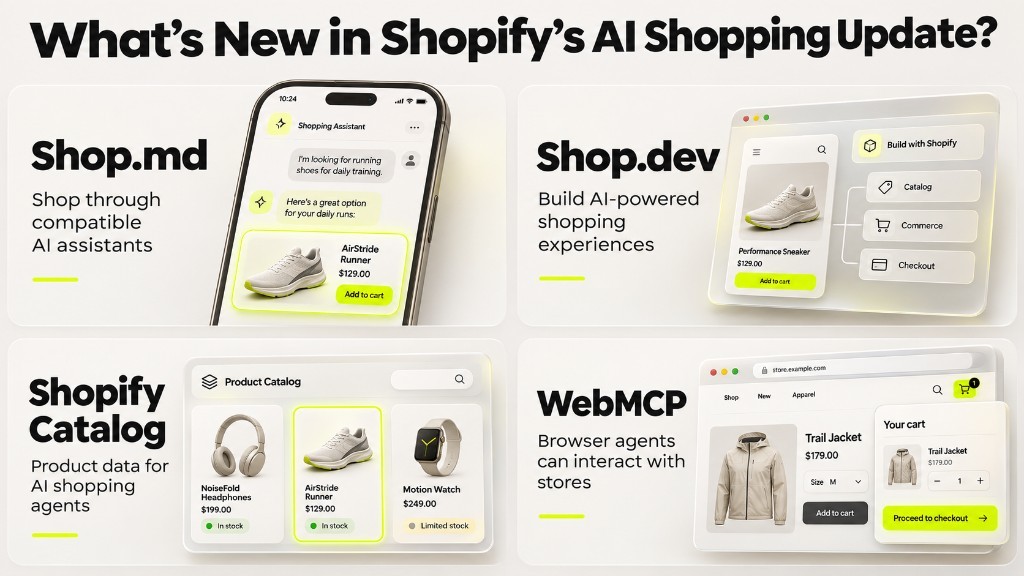
In its Fall '26 Edition, Shopify introduced several ways for developers and AI assistants to interact with its commerce infrastructure:
- Shop.md: A shopping skill for compatible AI assistants to find products and help customers purchase through Shop Pay.
- Shop.dev: Developer access to Shopify's catalogue, customer sign-in, carts and checkout functionality.
- Shopify Catalog: Product information such as prices, variants and availability made accessible to supported shopping agents.
- WebMCP: Structured tools on supported Shopify storefronts that let compatible browser agents search catalogues, update carts and interact with checkout rather than relying solely on visual clicks.
WebMCP is still emerging, with limited browser-agent support, while Shopify Catalog requires products to meet eligibility criteria. These tools also do not automatically change how a Shopify website looks. The bigger change is that customers may find and buy products through compatible AI assistants before visiting the store themselves.
How will AI shopping agents change the customer journey?
Traditional online shopping requires customers to browse websites, compare products and complete purchases themselves. AI-assisted shopping offers another route:
- Conversational discovery: AI product discovery allows shoppers to describe what they need, such as a wireless office printer within a budget, while an assistant searches accessible product catalogues. Complete specifications and accurate descriptions help agents identify relevant products.
- Faster comparisons: Agents can compare prices, variants, availability and delivery options across supported sources, reducing the number of product pages customers need to open. Outdated information can produce misleading recommendations.
- Agent-assisted checkout: Supported agents can prepare carts and initiate checkout, and some integrations support completing purchases within the assistant. Merchants still process orders through their commerce systems; customer approval or authentication may be required.
For retailers, product discovery and purchasing increasingly extend beyond the storefront interface.
How do AI agents connect to eCommerce platforms?
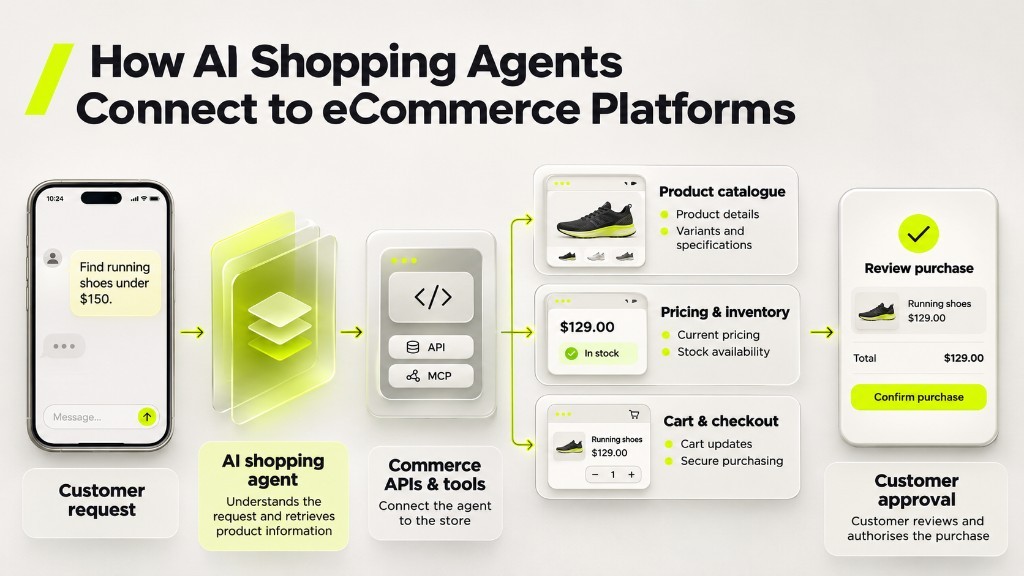
An agent needs a dependable way to access product information and perform approved actions. Three technologies are relevant.
APIs: Accessing commerce functions
An Application Programming Interface (API) lets systems exchange information through defined requests and responses. An eCommerce API might return a product's price, sizes and stock status, allowing an agent to answer a shopper's question without opening each product page. APIs may also support cart updates and order creation, subject to platform permissions.
MCP and WebMCP: Giving agents tools
The Model Context Protocol (MCP) connects AI applications to external tools and data. Shopify uses MCP-based interfaces for product discovery and commerce actions. WebMCP lets compatible browser agents use tools offered by a website: for example, Shopify's search_catalog retrieves matching products, while update_cart changes a shopper's cart. Structured tool calls can be more dependable than navigating buttons visually.
Universal Commerce Protocol: Supporting checkout
The Universal Commerce Protocol (UCP) defines a standardised way to support commerce interactions, including carts and checkout. Shopify uses UCP in agent-facing purchasing workflows, with customer handoff where required. Its agent checkout documentation explains supported flows and limitations.
Customer request → AI assistant → Commerce tools and APIs → Catalogue and inventory → Cart → Secure checkout
An agent is only as useful as the systems behind it. Poor product data, stale stock information or unreliable integrations can undermine the experience.
How should businesses prepare their eCommerce systems?
Start with the infrastructure you already have. These five areas usually matter more than adding a conversational interface to your website.
1. Structure your product data
Maintain descriptive titles, product specifications, sizes, variants, identifiers such as SKUs or GTINs where relevant, and clear delivery and return information. Ensure prices and availability are correct. Google's merchant listing guidance explains useful structured product attributes, although search schema and agent-facing commerce APIs are different technologies.
2. Synchronise inventory and pricing
If an agent recommends an available size that is actually sold out, the customer may discover the problem only at checkout. Review how your storefront connects to warehouse management, ERP and inventory systems. APIs, webhooks or scheduled synchronisation should keep stock and pricing dependable across sales channels.
3. Review your APIs and integrations
Review your eCommerce API integration capabilities, including product lookup, stock checks, carts and orders. Evaluate data accuracy, authentication, rate limits, error handling and connections to fulfilment systems. An existing API does not automatically make a store compatible with every AI agent; the assistant must support the relevant tools and permissions.
4. Protect the checkout process
Verify that agent-assisted flows preserve shipping rules, discounts, taxes, payment checks and customer consent. Some purchases still require the shopper to complete authentication or checkout directly with the merchant. Do not allow an agent to bypass normal transaction validation.
5. Test and monitor real scenarios
Track failed requests, unavailable variants, cart errors and interrupted checkouts. Test expired promotions, stock changes, unsupported destinations and API outages. These checks help reveal whether your systems remain reliable when a software agent, rather than a person clicking through pages, starts the transaction.
Are Shopify, WooCommerce, Magento and custom platforms equally prepared?
No. Shopify offers native agentic commerce tools, while other platforms provide different APIs and integration options. Availability of an API does not mean equivalent agent support is built in.
| Platform | Existing foundation | Preparation priority |
|---|---|---|
| Shopify | Catalog, WebMCP and agent-facing commerce tools | Check eligibility, catalogue quality and supported checkout flows |
| WooCommerce | REST API and Store API | Assess extensions, data access and custom agent integrations |
| Magento / Adobe Commerce | GraphQL and commerce APIs | Review customisations, catalogue services and integration architecture |
| Custom platform | Depends on its architecture | Evaluate APIs, data models, permissions and checkout |
WooCommerce and Adobe Commerce document APIs for core commerce operations, but businesses should verify what additional development is needed for agent compatibility. Migrating platforms is not necessarily required if an existing store has reliable data, secure APIs and adaptable checkout infrastructure.
What are the security risks of AI-driven shopping?
Commerce agents should have only the permissions needed for a specific task. Reading public product listings is different from accessing customer accounts or initiating payments, so authentication and authorisation must be enforced at the API and commerce-platform level.
Customer approval remains essential for purchases. Businesses should validate prices, order totals and payment requirements independently of an agent's instructions. Agent workflows also need safeguards against misleading product content, untrusted tool responses and accidental actions.
Is your eCommerce store ready for AI shopping agents?
Use this checklist to identify where your existing infrastructure needs work.
| Area | What to verify |
|---|---|
| Catalogue | Consistent specifications, variants and product identifiers |
| Inventory | Accurate stock and pricing across connected systems |
| APIs | Reliable access to required functions, with appropriate permissions |
| Integrations | Stable links to ERP, fulfilment and other operational systems |
| Checkout | Correct totals, secure payments and buyer approval |
| Monitoring | Visibility into errors, failed transactions and stock mismatches |
Prioritise problems that affect accurate recommendations or order completion. For example, fixing unreliable warehouse synchronisation may deliver more value than launching a new AI interface. Shopify merchants should also review Shopify Catalog eligibility; inclusion does not guarantee that an assistant will recommend a product.
How can Vedha help?
Vedha Technologies provides custom eCommerce development and integration services, helping businesses build and connect storefronts, product catalogues, inventory systems, payment solutions and related business applications. Our eCommerce development services can help assess whether your existing platform is equipped for emerging AI shopping experiences and identify improvements that make commercial and technical sense.
Preparing your online store for AI-driven shopping? Book a free consultation with Vedha to discuss your platform, integrations and development requirements.
FAQs
Can AI agents buy products without visiting a website?
In supported experiences, agents can discover products and assist with purchasing without sending customers through a traditional storefront. Some checkouts still require customer handoff or additional authentication.
Do I need Shopify to support AI shopping agents?
No. WooCommerce, Adobe Commerce and custom platforms may support suitable integrations, but their capabilities and development requirements differ from Shopify's native tools.
Will AI shopping agents replace eCommerce websites?
There is no basis to assume they will. AI assistants add another shopping route, while storefronts remain important for customer experience, direct purchases and brand presentation.
Do I need to rebuild my store for AI shopping?
Not necessarily. Better product data, reliable APIs and targeted integrations may be enough. The right approach depends on your existing architecture.